Thursday, 30 November 2017

Chain of Responsibility Design Pattern


Motivation
In writing an application of any kind, it often happens that the event generated by one object needs to be handled by another one. And, to make our work even harder, we also happen to be denied access to the object which needs to handle the event. In this case there are two possibilities: there is the beginner/lazy approach of making everything public, creating reference to every object and continuing from there and then there is the expert approach of using the Chain of Responsibility.
The Chain of Responsibility design pattern allows an object to send a command without knowing what object will receive and handle it. The request is sent from one object to another making them parts of a chain and each object in this chain can handle the command, pass it on or do both. The most usual example of a machine using the Chain of Responsibility is the vending machine coin slot: rather than having a slot for each type of coin, the machine has only one slot for all of them. The dropped coin is routed to the appropriate storage place that is determined by the receiver of the command.

Intent
It avoids attaching the sender of a request to its receiver, giving this way other objects the possibility of handling the request too.
The objects become parts of a chain and the request is sent from one object to another across the chain until one of the objects will handle it.

Applicability
Use Chain of Responsibility when
1. more than one object may handle a request, and the handler isn't known a prior. The handler should be ascertained automatically.
2. you want to issue a request to one of several objects without specifying the receiver explicitly.
3. the set of objects that can handle a request should be specified dynamically.

Benefit(s)
1. Reduced coupling.
2. Added flexibility in assigning responsibilities to objects.

Disadvantage(s)
1. Receipt isn't guaranteed.

Happy Learning.

Abstract Factory Design Pattern


Motivation
Modularization is a big issue in today's programming. Programmers all over the world are trying to avoid the idea of adding code to existing classes in order to make them support encapsulating more general information. Take the case of a information manager which manages phone number. Phone numbers have a particular rule on which they get generated depending on areas and countries. If at some point the application should be changed in order to support adding numbers form a new country, the code of the application would have to be changed and it would become more and more complicated.
In order to prevent it, the Abstract Factory design pattern is used. Using this pattern a framework is defined, which produces objects that follow a general pattern and at runtime this factory is paired with any concrete factory to produce objects that follow the pattern of a certain country. In other words, the Abstract Factory is a super-factory which creates other factories (Factory of factories).

Intent
Abstract Factory offers the interface for creating a family of related objects, without explicitly specifying their classes.

Where to use
Abstract Factory should be used when:
A system should be configured with one of multiple families of products
A system should be independent of how its products are created, composed and represented
Products from the same family should be used all together, products from different families ahould not be used together and this constraint must be ensured.
Only the product interfaces are revealed, the implementations remains hidden to the clients.

Common Usage
Examples of abstract factories:
java.awt.Toolkit - the abstract superclass of all actual implementations of the Abstract Window Toolkit. Subclasses of Toolkit are used to bind the various components to particular native toolkit implementations(Java AWT).
javax.swing.LookAndFeel - an abstract swing factory to swithct between several look and feel for the components displayed(Java Swing).
java.sql.Connection - an abstract factory which create Statements, PreparedStatements, CallableStatements,... for each database flavor.
Example: Gui Look & Feel in Java

Applicability
Use the Abstract Factory pattern when
1. a system should be independent of how its products are created, composed, and represented.
2. a system should be configured with one of multiple families of products.
3. a family of related product objects is designed to be used together, and you need to enforce this constraint.
4. you want to provide a class library of products, and you want to reveal just their interfaces, not their implementations.

Benefit(s)
1. It isolates concrete classes.
2. It makes exchanging product families easy.
3. It promotes consistency among products.

Disadvantage(s)
1. Supporting new kinds of products is difficult.

Happy Learning.

Factory Design Pattern


Motivation
The Factory Design Pattern is probably the most used design pattern in modern programming languages like Java and C#. It comes in different variants and implementations. If you are searching for it, most likely, you'll find references about the GoF patterns: Factory Method and Abstract Factory.

Intent
creates objects without exposing the instantiation logic to the client.
refers to the newly created object through a common interface

Where to use
Factory pattern should be used when: - a framework delegate the creation of objects derived from a common superclass to the factory - we need flexibility in adding new types of objects that must be created by the class

Common Usage
Along with singleton pattern the factory is one of the most used patterns. Almost any application has some factories. Here are a some examples in java:
- factories providing an xml parser: javax.xml.parsers.DocumentBuilderFactory or javax.xml.parsers.SAXParserFactory
- java.net.URLConnection - allows users to decide which protocol to use.

Applicability
Use the Factory Method pattern when 1. a class can't anticipate the class of objects it must create. 2. a class wants its subclasses to specify the objects it creates. 3. classes delegate responsibility to one of several helper subclasses, and you want to localize the knowledge of which helper subclass is the delegate.

Benefit(s)
1. Provides hooks for subclasses.
2. Connects parallel class hierarchies.

Disadvantage(s)
A potential disadvantage of factory methods is that clients might have to subclass the Creator class just to create a particular ConcreteProduct object. Subclassing is fine when the client has to subclass the Creator class anyway, but otherwise the client now must deal with another point of evolution.


Happy Learning.

Singleton Design Pattern


Motivation
Sometimes it's important to have only one instance for a class. For example, in a system there should be only one window manager (or only a file system or only a print spooler). Usually singletons are used for centralized management of internal or external resources and they provide a global point of access to themselves.
The singleton pattern is one of the simplest design patterns: it involves only one class which is responsible to instantiate itself, to make sure it creates not more than one instance; in the same time it provides a global point of access to that instance. In this case the same instance can be used from everywhere, being impossible to invoke directly the constructor each time.

Intent
Ensure that only one instance of a class is created.
Provide a global point of access to the object.

Where to use
Singleton pattern should be used when we must ensure that only one instance of a class is created and when the instance must be available through all the code. A special care should be taken in multi-threading environments when multiple threads must access the same resources through the same singleton object.

Common Usage
There are many common situations when singleton pattern is used:
- Logger Classes
- Configuration Classes
- Accessing resources in shared mode
- Other design patterns implemented as Singletons: Factories and Abstract Factories, Builder, Prototype

Example: Lazy Singleton in Java, Early Singleton in Java

Applicability
Use the Singleton pattern when 1. there must be exactly one instance of a class, and it must be accessible to clients from a wellknown access point. 2. when the sole instance should be extensible by subclassing, and clients should be able to use an extended instance without modifying their code.

Benefit(s)
1. Controlled access to sole instance.
2. Reduced name space.
3. Permits refinement of operations and representation.
4. Permits a variable number of instances.
5. More flexible than class operations.

Happy Learning.

Friday, 8 September 2017

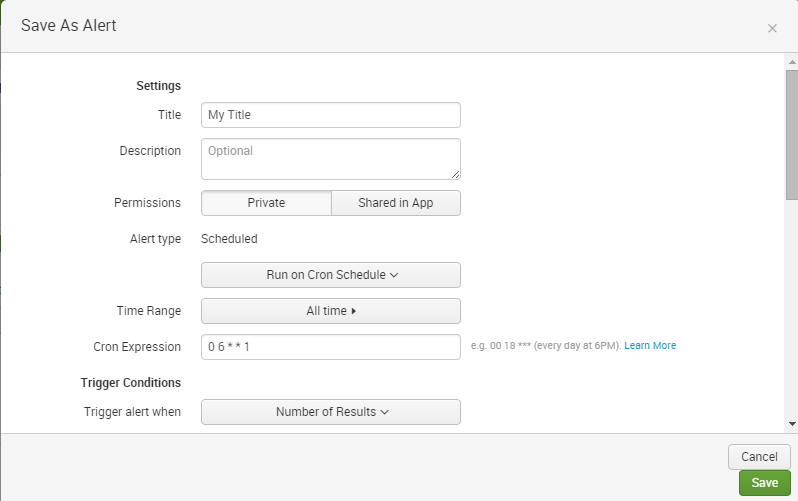
How to Create alerts in Splunk


The Steps include:


  • Open Search page in Search and Reporting Page.
  • Enter your query for which alerts need to be triggered.for example:
         index = os_web sourcetype = custom-prod-up-ext serviceName=SHARP response=failure                  feature=PCI_DE_TOKENIZATION 
  • Select Save as ---->Alert


  • Next Specify Setting,Triggered Condition,Triggered Action.


  • Select Save.

Enjoy Learning.

Tuesday, 29 August 2017

Java program to check unique number


Sample Program:-


 import java.util.*;  
 import java.io.*;  
 /**  
  * Created by Dixit on 29-08-2017.  
  */  
 public class IsUniqueNumber {  
   public static boolean  
   isUniqueUsingHash(String word)  
   {char[] chars = word.toCharArray();  
     Set<Character> set = new HashSet<Character>();  
     for (char c : chars)  
       if (set.contains(c))  
         return false;  
       else {  
         set.add(c);  
       }  
     return true;  
   }  
   public static boolean  
   isUniqueUsingSort(String word)  
   {char[] chars = word.toCharArray();  
     if (chars.length <= 1)  
       return true;  
     Arrays.sort(chars);  
     char temp = chars[0];  
     for (int i = 1; i < chars.length; i++)  
     {if (chars[i] == temp)  
       return false;  
       temp = chars[i];  
     }  
     return true;  
   }  
   public static void main(String[] args)  
       throws IOException  
   {  
     System.out.println(isUniqueUsingHash("1234")? "Unique" : "Not Unique");  
         System.out.println(isUniqueUsingSort("123")? "Unique" : "NotUnique");  
   }  
 }  


Enjoy Coding

Sunday, 20 August 2017

Interesting facts of Java


Java programming language was originally developed by Sun Microsystems which was initiated by James Gosling and released in 1995 as core component of Sun Microsystems' Java platform (Java 1.0 [J2SE]).
The latest release of the Java Standard Edition is Java SE 8. With the advancement of Java and its widespread popularity, multiple configurations were built to suite various types of platforms. Ex: J2EE for Enterprise Applications, J2ME for Mobile Applications.
The new J2 versions were renamed as Java SE, Java EE and Java ME respectively. Java is guaranteed to be Write Once, Run Anywhere.
Java is:
  • Object Oriented: In Java, everything is an Object. Java can be easily extended since it is based on the Object model.
  • Platform independent: Unlike many other programming languages including C and C++, when Java is compiled, it is not compiled into platform specific machine, rather into platform independent byte code. This byte code is distributed over the web and interpreted by virtual Machine (JVM) on whichever platform it is being run.
  • Simple: Java is designed to be easy to learn. If you understand the basic concept of OOP Java would be easy to master.
  • Secure: With Java's secure feature it enables to develop virus-free, tamper-free systems. Authentication techniques are based on public-key encryption.
  • Architectural-neutral: Java compiler generates an architecture-neutral object file format which makes the compiled code to be executable on many processors, with the presence of Java runtime system.
  • Portable: Being architectural-neutral and having no implementation dependent aspects of the specification makes Java portable. Compiler in Java is written in ANSI C with a clean portability boundary which is a POSIX subset.
  • Robust: Java makes an effort to eliminate error prone situations by emphasizing mainly on compile time error checking and runtime checking.
  • Multithreaded: With Java's multithreaded feature it is possible to write programs that can do many tasks simultaneously. This design feature allows developers to construct smoothly running interactive applications.
  • Interpreted: Java byte code is translated on the fly to native machine instructions and is not stored anywhere. The development process is more rapid and analytical since the linking is an incremental and light weight process.
  • High Performance: With the use of Just-In-Time compilers, Java enables high performance.
  • Distributed: Java is designed for the distributed environment of the internet.
  • Dynamic: Java is considered to be more dynamic than C or C++ since it is designed to adapt to an evolving environment. Java programs can carry extensive amount of run-time information that can be used to verify and resolve accesses to objects on run-time.

Enjoy Learning.